
%209_15_34%E2%80%AFp_%C2%A0m_.png)
A TOUR THROUGH THE MOSAIC:
A NEW PERSPECTIVE
Stories that time has not erased
There are stories we can still read thousands of years after someone told them. They are in the colors of a floor, in the figures on a wall, and in the small pieces placed by hands long before we existed. At Bisanzio, we believe that mosaics have this ability to bring us closer to other lives, because thanks to the resistance of their materials and their preservation, an image can outlive those who created it and continue speaking to those who will come long after.
Before reaching your table, the mosaic passed through many places, decorated temples, told stories on the floors and walls of houses, and transformed entire buildings, and although its materials and styles have changed a lot over time, the idea behind it that fascinates us remains the same: the wonderful act of building something that only makes sense by meticulously working on every little detail.
It all started with a little clay
More than 5,000 years ago, in Mesopotamia, in the territory we know today as Iraq, the builders of Uruk decorated the walls of their monumental enclosures with small clay cones. They inserted the pointed end into the wall plaster and left the colored tips visible, placing them side by side to form rhombuses, bands, and zigzags.
These coverings are among the earliest antecedents of mosaic and show us that, long before tesserae as we know them today (the small pieces with which we compose a work), there was already that desire in the world to build images fragment by fragment.
%207_34_07%E2%80%AFp_%C2%A0m_.png)
%207_33_55%E2%80%AFp_%C2%A0m_.png)
When stones learned to paint
Much later, in ancient Greece, we find, once again, that same desire that we saw in the pebble mosaics of the 5th and 4th centuries BC. The artisans of the time used small river stones of different colors to decorate the floors and, taking advantage of their natural shapes, created geometric compositions, animals and scenes that seemed to be in motion.
Over time, they also began to use small, carved pieces of stone, whose shapes they could adjust and place closer together. This allowed them to achieve more precise outlines, color transitions, and increasingly delicate details, eventually transforming the stones into a true form of painting. Where we once saw small fragments, muscles, folds, shadows, and gazes began to appear.
%207_35_21%E2%80%AFp_%C2%A0m_.png)

And that style of painting remained beneath our feet
From the 2nd century BC onwards, mosaics flourished in the Roman world, spreading throughout houses, villas, baths, and other spaces. Floors were filled with animals, mythological scenes, geometric designs, and details of daily life. A floor could embellish a room, impress visitors, and express the tastes or social standing of its owners; thus, decoration also became a way of presenting oneself to others.
The mosaics preserved from that era still allow us to glimpse that world, and if you are reading this in our studio, we want to tell you that you are lucky to be able to find some examples very close to here.
One of these places is Santiponce, a small town less than an hour from Seville, home to Italica, founded in 206 BC and considered the first Roman settlement outside the Italian peninsula. There you can admire mosaics in the remains of the houses for which they were created, relate their designs to the rooms they decorated, and imagine the life that unfolded around them. Another place to continue discovering them, even closer, is the Palace of the Countess of Lebrija, right here in the heart of Seville.
In this palace, at the beginning of the 20th century, the countess assembled a collection of Roman mosaics and incorporated them as part of the house, integrating them into its courtyards and rooms.
These works found a new leading role many centuries after their creation, allowing us today to explore a house where different eras coexist with great majesty.
%208_58_48%E2%80%AFp_%C2%A0m_.png)
%209_00_38%E2%80%AFp_%C2%A0m_.png)
From the ground, the gaze rose towards the light
Although mosaics were already used on walls, with the development of Christian and Byzantine art, church interiors became one of their most extraordinary settings.
And to situate ourselves, we are going to travel to Constantinople, the imperial capital established in the year 330 on the ancient city of Byzantium (present-day Istanbul), and from where the empire that we know today as Byzantine, heir to the Roman Empire, was governed.
During this period, Christianity had become the official religion of the Roman state, and for centuries afterward, architecture and religious imagery contributed to expressing this faith and its relationship with imperial power. Within these spaces, however, color, which already had a long history in mosaics, acquired a dazzling presence when it encountered light. Green, blue, and red glass was used alongside gold backgrounds, making the material itself an essential part of the experience of the buildings.
The scale of the architecture, the brilliance of the mosaics, and the sacred imagery all contributed to generating awe and a sense of closeness to the divine. Some observers of the time even interpreted the great dome of Hagia Sophia as heaven itself.
Shaping all of that required the collaboration of many expert hands, even centuries after its construction. And so, different generations have managed to leave their mark on the same place, preserving the works that have reached us today, those stories of change, loss, and care.
%209_03_03%E2%80%AFp_%C2%A0m_.png)
%209_09_16%E2%80%AFp_%C2%A0m_.png)
And while some stories shone, others found their form in geometry
The journey doesn't end in the Byzantine world. While its mosaics continued to evolve, other traditions explored new ways of combining shapes and colors. And of course, they also left their mark on Seville.
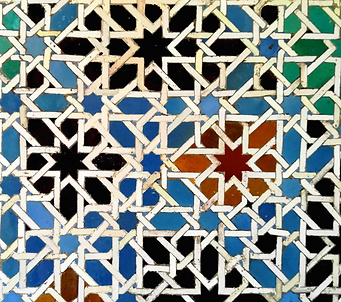
In the Islamic world, geometry found a privileged place in architectural decoration and, in al-Andalus, one of its most fascinating expressions was tilework, whose compositions reached a great development between the end of the 13th and 14th centuries.
In this technique, glazed ceramic tiles were cut into shapes that were then assembled to create larger compositions. Stars, bows, and other pieces fit together, so that the design emerged precisely from their union. Each fragment had a function within the whole, and the precision of the cut allowed the colors and lines to intertwine across the surface. Some of its most refined examples can be found in Nasrid decorations here in Seville, in the palace of Pedro I in the Royal Alcázar, built in the 14th century, in certain areas of Plaza de España, and in the Casa de Pilatos.
These tilework patterns have formed a significant part of the language of Mudéjar art, which incorporated techniques and forms from Islamic tradition into buildings constructed under Christian rule. They bear witness to knowledge and crafts that transcended cultural boundaries and found new ways to continue.
Another very interesting thing about this technique is that if you follow one of its lines with your eyes, you will discover how it crosses, turns, and reappears.
The repetition and symmetry create the feeling that the drawing could continue even beyond the wall, as if what we see were only part of a much larger composition. And yet, it all begins with something you already know: a small piece that finds its place next to another.
%209_07_08%E2%80%AFp_%C2%A0m_.png)
%209_06_22%E2%80%AFp_%C2%A0m_.png)
Centuries later, the pieces also found freedom in the curves
At the end of the 19th and beginning of the 20th centuries, modernism opened up other possibilities for mosaics: Trencadís, made with irregular fragments of ceramic and other materials, which allowed curved surfaces to be covered with compositions full of freedom.
With Antoni Gaudí, mosaics embraced benches, facades, and forms that seemed to grow like nature itself. In these works, a broken piece could find a new place. The unexpected edge, the curve of a fragment, or part of a previous design became part of a different composition, and this way of working allowed for the discovery of possibilities in materials that seemed to have reached the end of their useful life.
And while the city of Barcelona boasts some of the most famous examples within Spain, this story also has a stop near Seville. In Alcalá de Guadaíra, the Dragon Bridge, inaugurated in 2007 and designed by engineers José Luis Manzanares and Íñigo Barahona, spans 123 meters across the river, transformed into an enormous creature covered in mosaics, showing us just how far this incredible art form can go.
%209_09_51%E2%80%AFp_%C2%A0m_.png)
%209_09_44%E2%80%AFp_%C2%A0m_.png)
And now, this story continues in your hands.
Mosaics continue to evolve and find their place in sculptures, public spaces, everyday objects, and personal works. Each era contributes its materials, colors, and stories, and today, at this table, you too are making those choices. Perhaps you've changed a color, discovered an unexpected shape, or realized that a piece that seemed out of place actually had its own spot.
After so many centuries, something very simple and extraordinary continues to happen: small pieces meet and, in your hands, begin to become something new.
The mosaic is once again proof that things don't end when they break, they only transform.
And, if you've made it this far, we hope that this transformation has also stirred something within you: the joy of creating something with your hands, an idea that wasn't there before, or a moment of calm that you needed to see things in perspective and put a few pieces together.
If, in addition to taking your mosaic home, you take something else with you today, in this studio, we feel that our work has had meaning.
Thank you for sharing your time and your story with us.
For allowing us to keep the teachings of the mosaic alive.
With love,
Bisanzio Mosaic Studio